
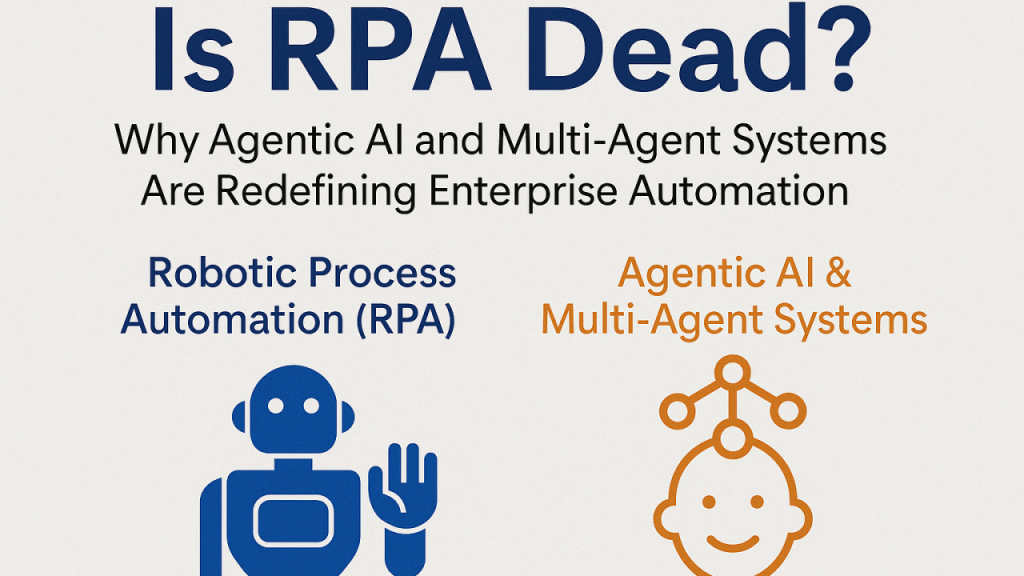
The 2026 Shift: We are moving from “Process-based” automation (doing things the same way every time) to “Outcome-based” automation (giving an AI a goal and letting it figure out the best path to reach it). In 2026, if your automation doesn’t have “agency,” it’s already a legacy system.
Table of Contents
- The RPA Wall: Why Traditional Bots are Failing in 2026
- What is Agentic AI? (Reasoning vs. Rules)
- The ‘Agentic’ Difference: A Real-World Comparison
- Agentic ROI: Why it’s the Best Investment for 2026
- The Eduglar Roadmap: From Static Bots to Intelligent Agents
<a name=”rpa-wall”></a>
1. The RPA Wall: Why Traditional Bots are Failing in 2026
Traditional RPA works like a train on a track. It is incredibly fast, but if there is even a small pebble on the track (an unexpected data format or a missing field), the train crashes.
- The Maintenance Trap: Indian IT teams spent 40% of their time in 2025 simply “fixing” broken RPA scripts.
- The Complexity Ceiling: RPA cannot handle “gray areas.” It can process an invoice, but it cannot negotiate a discount or handle a customer who is angry about a late delivery.
<a name=”what-is-agentic”></a>
2. What is Agentic AI? (Reasoning vs. Rules)
Agentic Workflows use Large Language Models (LLMs) as a reasoning engine. Instead of a script that says “If A, then B,” an Agentic system is given a goal: “Resolve this customer dispute while maintaining a 90% satisfaction score.”
- Decomposition: The agent breaks the goal into sub-tasks.
- Tool Use: It decides which “tools” to use (e.g., querying the CRM, checking the warehouse database, or drafting an email).
- Self-Correction: If the first path fails, the agent tries a different approach without needing a human to rewrite its code.
<a name=”comparison”></a>
3. The ‘Agentic’ Difference: A Real-World Comparison
Let’s look at how a Loan Processing workflow has evolved by 2026:
| Feature | Traditional RPA (2022-2024) | Agentic Workflow (2026) |
| Data Input | Only structured Excel/CSV files. | Unstructured emails, PDFs, and voice notes. |
| Handling Errors | Stops and alerts a human. | Self-heals by asking the user for clarification. |
| Decision Making | Strict “Yes/No” based on credit score. | Contextual: Evaluates market trends and history. |
| Adaptability | Breaks if the bank’s portal UI changes. | Understands the intent of the button, regardless of UI. |
<a name=”roi”></a>
4. Agentic ROI: Why it’s the Best Investment for 2026
By February 2026, the “Early Adopters” in the Indian BFSI (Banking, Financial Services, and Insurance) sector are seeing massive gains:
- 70% Reduction in Manual Oversight: Humans only step in for the final “approval” signature.
- 3x Faster Cycle Times: Processes that took 3 days (like vendor onboarding) now take 3 hours.
- Lower API Costs: Intelligent agents don’t make redundant calls; they “think” before they act, saving on your cloud and token budgets.

<a name=”roadmap”></a>
5. The Eduglar Roadmap: From Static Bots to Intelligent Agents
At Eduglar, we don’t just build software; we build Digital Coworkers. ### Our Transition Strategy:
- The ‘Agentic Layer’ Audit: We identify which of your current RPA bots are “high-maintenance” and ready for an AI brain transplant.
- Goal-Oriented Design: We help you define “Business Objectives” rather than “Step-by-Step Scripts.”
- Human-in-the-Loop (HITL) Controls: We build “Guardrails” so your agents can act autonomously but always stay within your company’s ethical and legal policies.
Is your automation working for you, or are you working to keep your automation alive?
[Talk to an Eduglar Automation Specialist] | [Download the ‘RPA to Agent’ Migration Whitepaper]